Family Protection Tax
Gang Up: A Bikerland NovelThe Family Protection Tax is the price Temple’s residents are expected to pay for the Family’s protection, and a central mechanism by which the Family turns its armed authority into revenue and political control. Although Case presents collections as donations, the system is not voluntary: residents may live in Temple without paying, but only taxpayers receive the full benefits of protection. The tax therefore makes security conditional, while connecting everyday payments to the Family’s wider distribution of land, loot, labor, and women.
Purpose and Terms
The Family is organized to serve Temple and earns income by raiding surrounding territories, taking land, loot, and women for trade. Its members receive first choice of what is captured; the Kin, the people favored by the Family, come next; ordinary residents may receive a share only after those priorities and so long as they pay their taxes. The protection tax belongs to this larger order of controlled access: payment does not simply settle an obligation but identifies who is entitled to the practical advantages of Family rule.
The terms are backed by the Family’s armed power. Anyone may live in Temple, but residence alone does not qualify a person for the true protection the Family provides. The distinction allows the Family to describe its rule as a service while withholding that service from those who do not contribute. Security is thus both the justification for collection and one of its selective rewards.
Collection in the Tavern
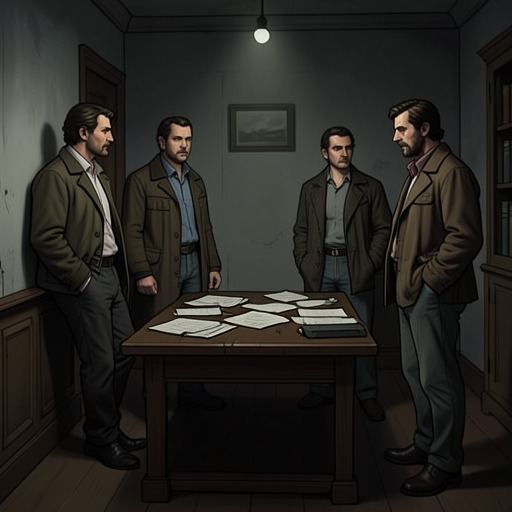
The collection is shown as a public routine. Case and Troy enter a crowded tavern after farmers have returned from the fields and traders have finished their business. The men inside are playing cards, rolling dice, drinking, and talking when Case raps on a table and announces that the time has come for Family donations. The groans that follow make clear that the payment is unwelcome, not a freely offered gift.
Case explains the exchange in direct terms: the Family keeps the residents safe, and anyone who wants to remain protected must keep the fund going. While Case speaks, Troy carries a thick leather pouch from table to table. When one man fails to pay promptly, Troy hits him in the face with the pouch. The threat makes the collection effective; the bag soon fills with clinking currency. The episode exposes the force beneath the language of protection and donation: Case supplies the rationale, while Troy enforces it physically.
The payment is collected in a common postwar currency of gold, silver, and bronze pieces, used across Texas. The narrative notes a legend that the coins were made from the wealth taken from old Fort Knox by an early founder of postwar Dallas, but presents that origin as uncertain. Whatever their history, the coins are widely used and turn the Family’s demand into a recognizable monetary levy.
Payment in Daughters and Other Rewards
The system also permits payment through a daughter. During the tavern collection, Hanley, a barber and dentist, says he has no money that week and offers his daughter, Evelina, who is of age. Troy agrees to look at her but makes no promise. The exchange reveals that the tax is not limited to coins: a family may offer a young woman to the Family as a form of settlement, placing her within the same economy of bodies and favors that supports the Family’s rule.
A father who gives a daughter to the Family effectively clears any debt he owes for a year. If he has no debt, the arrangement brings an additional advantage: he may choose land, loot, or women before other residents. The offer therefore has consequences beyond the immediate account. It can cancel an obligation and improve a household’s position in the distribution of rewards, making the daughter’s transfer a means of securing economic and political favor for her father.
The institution also shapes family life. In Temple, having daughters can mean more protection and favor, while a father’s treatment of his daughter may affect whether a Family member takes an interest in her and whether his debts are forgiven. Sons matter too: if a son enters the Family, his entire clan shares in the benefits. The tax system thus reaches beyond the moment of collection, influencing how residents value children and how households seek security within the Family’s hierarchy.
Governance and the Wider Economy
The tax works alongside the Family’s internal distribution of resources. Titus makes the Family’s overarching decisions about whom to attack, whom to trade with, and where to fortify or retreat. Sandra, as Matron, helps ensure that warriors are fed and supplies delivered, as well as overseeing the distribution of women. These arrangements show that the protection fund is part of a broader system of maintaining the Family’s power and rewarding its members, rather than an isolated charge collected from townspeople.
The collection scene ends with another breach of the supposed public purpose of the fund. After Case and Troy have gathered money from nearly everyone in the tavern and set off toward the Compound, Troy stops in an alley and removes large portions of the coins for himself. The theft does not erase the tax’s function, but it reveals that money gathered in the name of collective protection is vulnerable to private appropriation even within the Family’s own ranks.
Later, the settlement between the Family and the Cauldron makes Temple’s economy more explicitly interdependent. The Cauldron is to manage trade routes and assist if Temple faces hostilities, while the Family retains control of Temple, maintains its security, and sends riders into the wastes to seek territory and resources. The Cauldron receives access to the Compound’s supplies and lodging, with some provisions free and others paid for. This arrangement is not a new statement of the protection tax’s collection rules, but it clarifies the larger political economy those rules serve: security, trade, access to resources, and the authority to distribute them are bound together. The tax’s decisive significance is that it makes protection an instrument of governance, placing Temple’s residents inside a system where payment determines not only what they owe, but what the Family may allow them to receive.